Net premium and options flow
How a trade's side is inferred, what net call and net put premium add up, what makes a flow a sweep or a block, and why money in the tape isn't intent.
The 30-second read
Net premium is the premium traders paid for a ticker's calls or puts, bought minus sold, added up through the session. Options flow picks out the single large trades. Both start from the same guess, the side each trade hit, and both show where money went, not why.
A trade's side
The tape doesn't say who bought. Each trade's side is inferred from where it printed against the quote just before it:
- At or above the ask, or above the mid: bought.
- At or below the bid, or below the mid: sold.
- At the mid exactly, without a quote, or reported late: neither.
A trade's premium is the dollars that changed hands: the price per share, times 100 shares a contract, times the contracts. A call bought or a put sold leans bullish; a call sold or a put bought leans bearish.
Net premium through the day
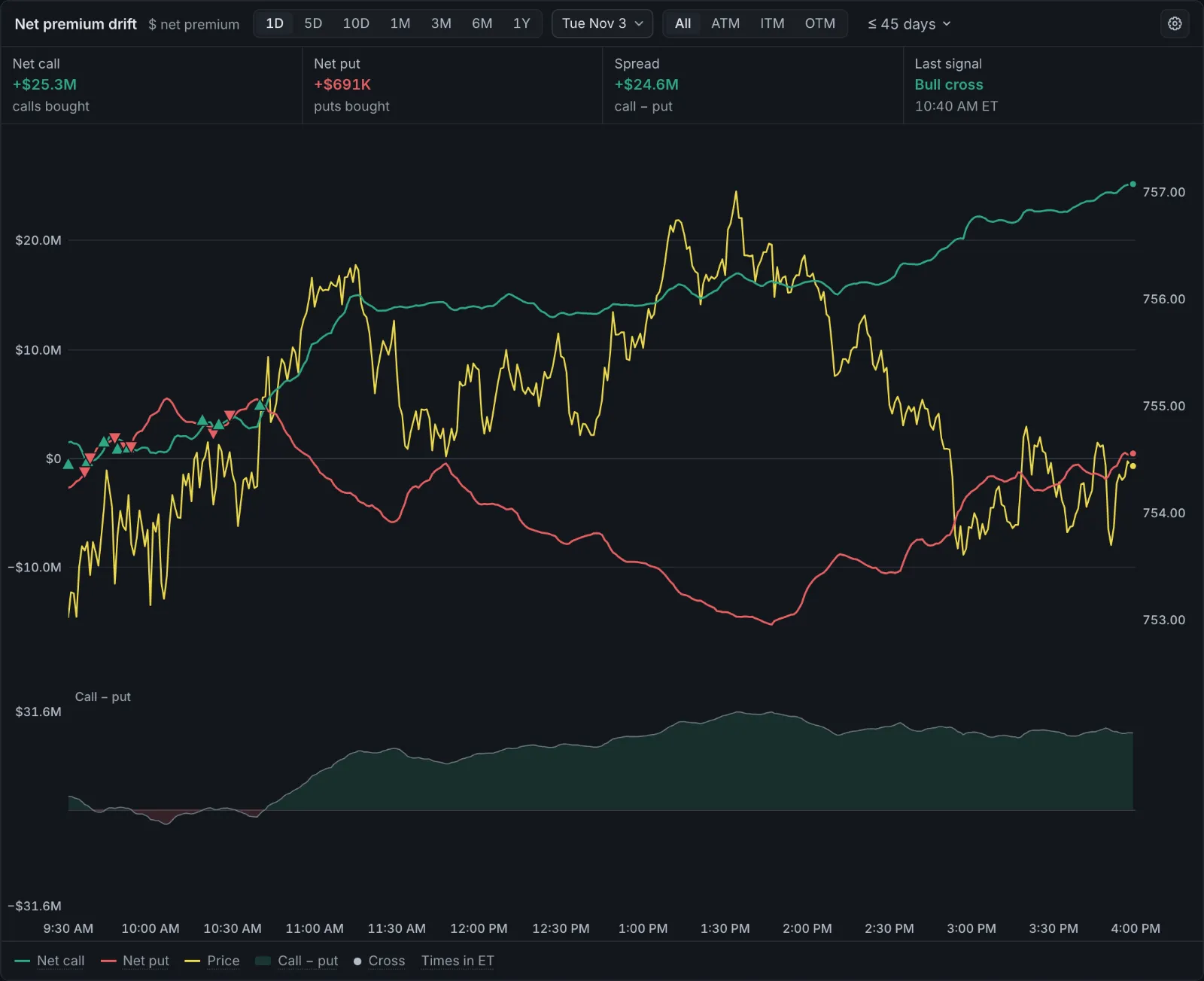
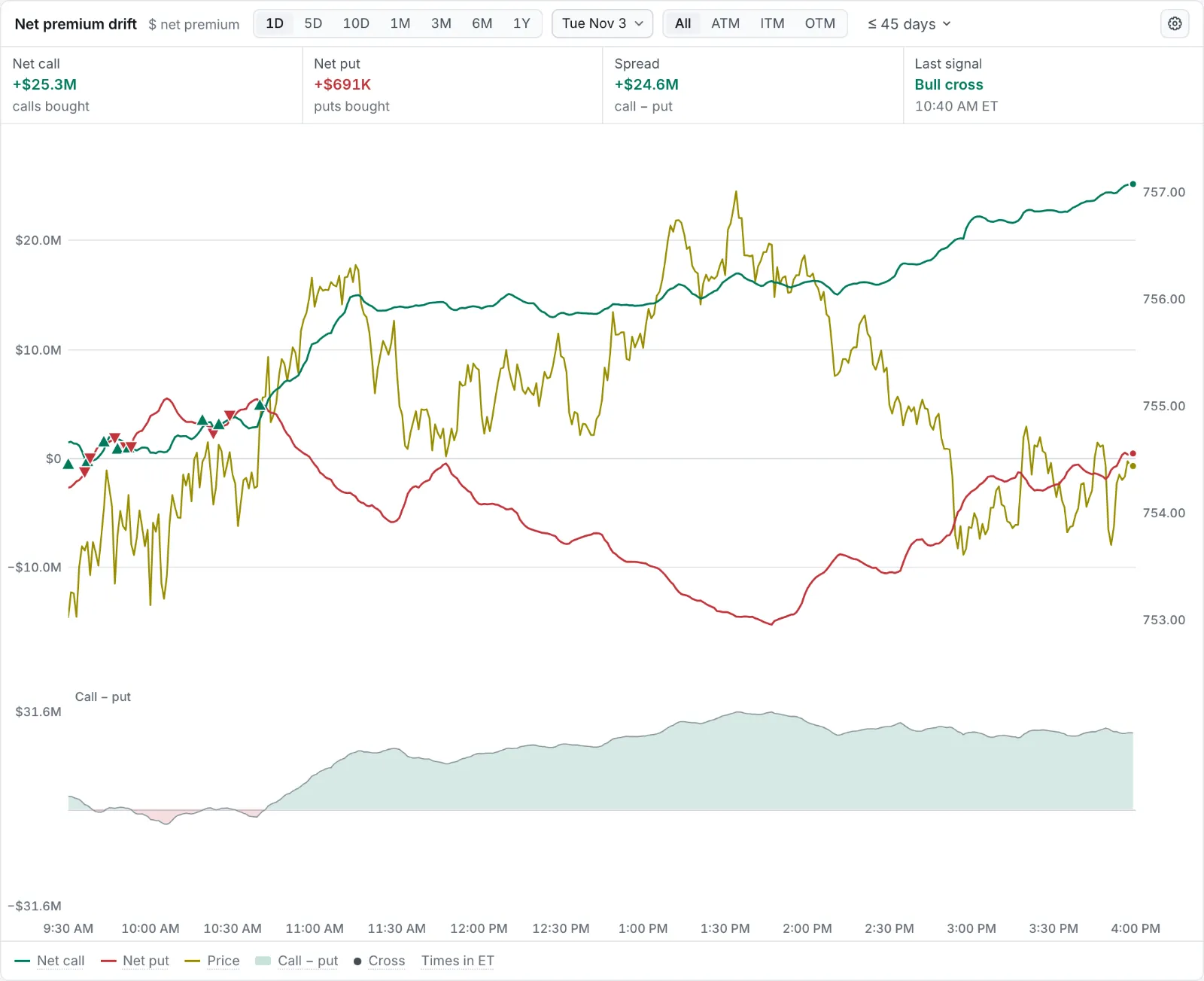
From the open, net call adds up the premium of calls bought less the premium of calls sold, and net put the same for puts. Two lines, plus their spread, make net premium drift. On Tue Nov 3, 2026, SPY's lines crossed 15 times in the first 70 minutes before a bull cross at 10:40 held; by the close net call was +$25.3M while SPY had moved from 753.03 to 754.44. Money leaned to calls all afternoon without the price following.
Flows
Options flow keeps only large trades, $100,000 or more and 50 contracts or more, grouped when one order fills in pieces:
- a sweep fills across several exchanges at once, an order in a hurry;
- a block is one large print;
- a split is several prints on one exchange;
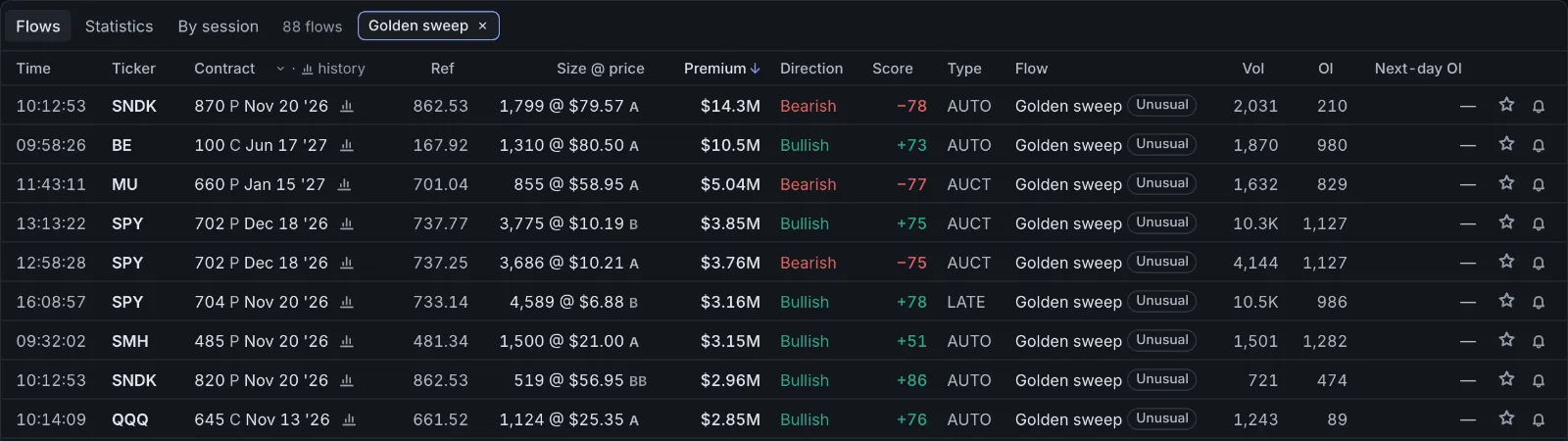
- a golden sweep is a sweep of $500,000 or more that's larger than the open interest.
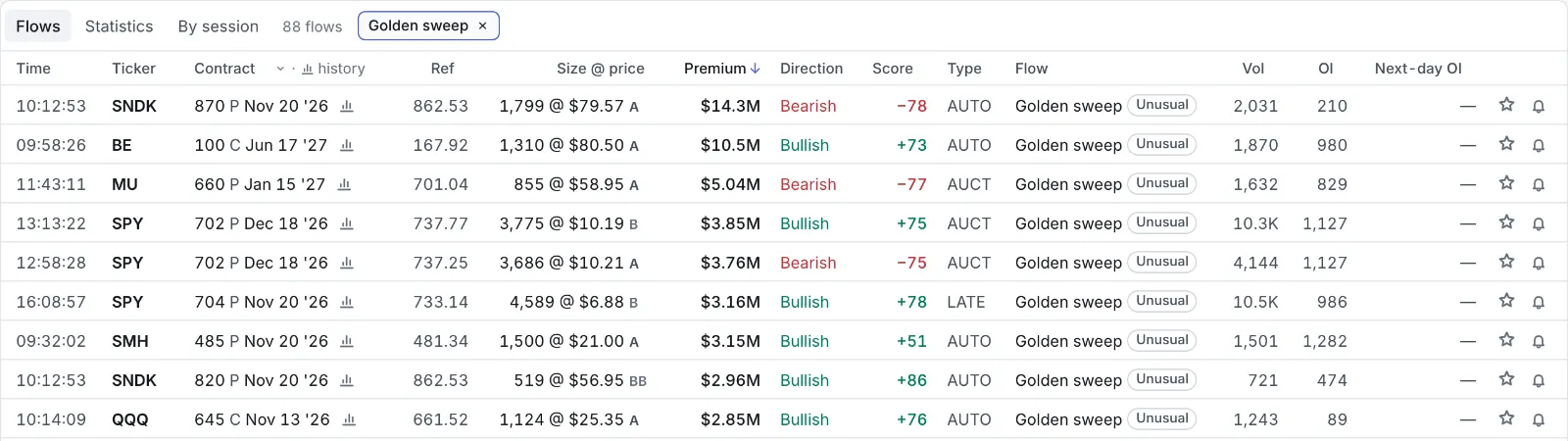
On Thu Nov 5, 2026, the session's largest golden sweep was SNDK's Nov 20 870 put: 1,799 contracts at the ask across 10 exchanges, $14.3M, against 210 contracts open.
How to use them
- Drift for the lean, flow for the trades behind it.
- Check size against open interest. More contracts than were open suggests a new position.
- Set both against the levels. Puts bought into a put wall, or calls sold at a call wall, say how traders are positioned around the dealers.
Where the model breaks
- The side is a guess. A trade between the bid and the ask can be either, and a fast market can leave the quote behind.
- Money isn't intent. A put bought may hedge a stock position; a call sold may be a covered call. Opening and closing look the same.
- Spreads can look directional. A spread printed as one package is left out, but one traded leg by leg counts as separate trades.
- One flow isn't a pattern. A large trade before a big move is memorable; the many before nothing are not.